

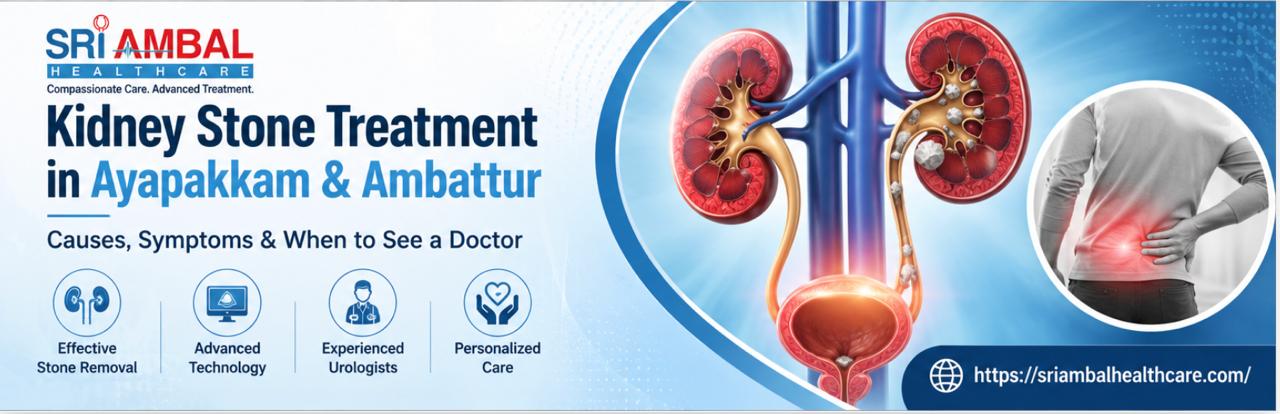
Kidney Stone Treatment in Ayapakkam & Ambattur Causes, Symptoms & When to See a Doctor
The pain arrives without warning. A sudden, severe cramping in the back or side, often radiating down toward the groin intense enough to stop you mid-step. Many people who experience it for the first time are convinced something has ruptured. In most cases, what they are feeling is a kidney stone and while extraordinarily painful, it is treatable.
At Sri Ambal Healthcare in Ayapakkam, our urology and skin & kidney stone care team treats patients from Ambattur, Thiruverkadu, Avadi, and the surrounding areas. You do not need to go to a large city hospital for expert kidney stone management.
What Is a Kidney Stone?
A kidney stone is a hard, crystalline deposit that forms inside the kidneys when certain minerals most commonly calcium, oxalate, and uric acid become highly concentrated in the urine and begin to crystallise. These stones can vary in size from a grain of sand to a golf ball, though most that cause symptoms are between 3–7mm.
Most stones pass naturally through the urinary tract. Others require medical intervention. The key is identifying them early, understanding their size and composition, and choosing the right treatment approach.
Why Chennai North Residents Are More Vulnerable
Kidney stones are significantly more common in hot, humid climates and Chennai’s summer months (March through June) see a sharp spike in kidney stone cases. Dehydration is the single largest risk factor, and residents who spend long hours outdoors or in physically demanding work environments are particularly vulnerable.
The other factor is diet. A diet high in salt, animal protein, and certain oxalate-rich foods combined with low water intake creates the perfect conditions for stone formation.
Recognising the Symptoms: What Kidney Stone Pain Actually Feels Like
Kidney stone pain medically called renal colic has a very specific character that differentiates it from muscular back pain or other conditions:
Classic Kidney Stone Symptoms
- Sudden, severe pain in the back, side, or below the ribs — pain that comes in waves
- Pain that radiates from the back toward the lower abdomen and groin as the stone moves
- Pain or burning sensation during urination
- Pink, red, or brown urine (blood in the urine — medically called haematuria)
- Cloudy or foul-smelling urine (may indicate infection)
- Nausea and vomiting during pain episodes
- Persistent urge to urinate, or urinating more frequently than usual
- Fever and chills (if infection is also present — this requires urgent care)
Important: Fever + kidney stone pain = medical emergency. This combination can indicate a blocked, infected kidney and requires immediate treatment.
Types of Kidney Stones
1. Calcium Oxalate Stones
The most common type, accounting for around 80% of all kidney stones. Formed when calcium combines with oxalate in the urine.
2. Uric Acid Stones
More common in people who eat high-protein diets, are dehydrated, or have gout. These stones are more common in men.
3. Struvite Stones
Typically form in response to urinary tract infections. More common in women. Can grow rapidly and become large (staghorn calculi).
4. Calcium Phosphate Stones
Associated with metabolic conditions like renal tubular acidosis.
5. Cystine Stones
Rare, caused by a hereditary condition that causes the kidney to excrete too much of a specific amino acid.
The type of stone is identified through urine analysis and stone composition testing — important for preventing future stones.
Diagnosis: How We Identify Kidney Stones
- Ultrasound — first-line investigation; safe, quick, and highly effective
- CT KUB (non-contrast CT scan) — the gold standard for detecting stones, their size, and exact location
- Urine analysis — checks for blood, crystals, and signs of infection
- Blood tests — calcium, uric acid, and kidney function tests
- 24-hour urine collection — for recurrent stone formers, to identify the metabolic cause
Our Urology team works closely with our Skin Care & Kidney Stone Centre to provide an integrated diagnosis and treatment pathway.
Treatment Options: From Natural Passage to Surgical Removal
Small Stones (Less Than 5mm) — Conservative Management
Most small stones pass naturally within 2–4 weeks with:
- High fluid intake (2.5–3 litres of water per day)
- Pain management medication
- Alpha-blocker medication to relax the ureter and aid passage
- Regular monitoring with follow-up ultrasound
Medium Stones (5–10mm) — Medical Expulsion Therapy
With appropriate medication and monitoring, many medium stones can still pass naturally. Our team manages this with regular review and imaging.
Larger or Blocked Stones — Interventional Treatment
ESWL — Extracorporeal Shock Wave Lithotripsy
A non-invasive procedure that uses focused sound waves to break the stone into smaller fragments that can then pass naturally through urine. No incision required.
Ureteroscopy (URS)
A thin, flexible telescope is passed through the urinary tract to reach the stone. It is then broken up using Holmium laser energy and removed. Highly effective for stones in the ureter.
PCNL — Percutaneous Nephrolithotomy
For large kidney stones (above 20mm) or staghorn calculi, a small incision is made in the back and the stone is removed directly. Our General Surgery and urology specialists collaborate for these cases.
Our goal is always the least invasive, most effective approach for each individual patient.
Kidney Stones and Skin: Understanding Our Combined Care Centre
You may have noticed Sri Ambal Healthcare’s service listed as “Skin & Kidney Stone Care” — and wondered about the combination. This is intentional. Certain systemic conditions — including some metabolic disorders, high uric acid levels, and dietary patterns — affect both the skin and the urinary tract simultaneously. Our integrated approach allows us to identify and treat the underlying cause rather than just the visible symptom.
Preventing Kidney Stones: What to Change Starting Today
Once you have had a kidney stone, your risk of forming another within 5 years is approximately 50%. Prevention is not optional — it is essential.
The Most Powerful Step: Drink More Water
Target 2.5 to 3 litres per day. Your urine should be pale yellow, not dark. If it is dark, you are already dehydrated.
Dietary Adjustments
- Reduce sodium — high salt increases calcium in urine. Avoid processed foods, pickles, and excess table salt
- Limit animal protein — red meat, poultry, and seafood increase uric acid and calcium excretion
- Eat calcium in food, not supplements — dietary calcium actually protects against oxalate stones
- Reduce oxalate-rich foods if you have had calcium oxalate stones — spinach, nuts, chocolate, and tea in excess
- Increase citrus — lemon juice in water naturally increases urinary citrate, which inhibits stone formation
Lifestyle Habits
- Maintain a healthy weight — obesity increases kidney stone risk
- Exercise regularly — but replace fluids lost through sweat immediately
- Avoid crash diets and very high-protein diets
- If diabetic or hypertensive, keep conditions well controlled
Recurrent Kidney Stones: Finding the Root Cause
If you have had more than one kidney stone, a metabolic work-up is essential. This involves blood and urine tests to identify:
- Hyperparathyroidism (excess parathyroid hormone)
- Hyperuricosuria (excess uric acid in urine)
- Hypercalciuria (excess calcium in urine)
- Rare conditions like cystinuria
Treating the root cause prevents future stones far more effectively than treating each stone individually. Our General Medicine team coordinates this metabolic evaluation for recurrent stone patients.
Frequently Asked Questions
Q: How do I know if I am passing a kidney stone or if it is something else?
A: Kidney stone pain is typically sudden, severe, one-sided, and moves from the back toward the groin. It often comes in waves. If you are unsure, visit our emergency department for an immediate ultrasound — do not self-diagnose.
Q: Can kidney stones damage my kidneys permanently?
A: Yes — if a stone blocks the kidney completely for an extended period, or if infection develops around a blocked stone, permanent kidney damage can occur. This is why prompt evaluation matters.
Q: Is kidney stone treatment painful?
A: Modern treatments like ureteroscopy and ESWL are performed under anaesthesia and are well-tolerated. Most patients go home the same day or within 24 hours.
Q: How long does recovery take after kidney stone treatment?
A: For ESWL and URS, most patients return to normal activity within 2–5 days. For PCNL, recovery is typically 5–7 days in hospital and 2 weeks at home.
Q: Can children get kidney stones?
A: Yes, though it is less common. If a child complains of back or abdominal pain along with changes in urine colour or frequency, they should be evaluated promptly.
Experiencing back pain or blood in your urine? Don’t wait. Book a Kidney Stone Consultation at Sri Ambal Healthcare, Ayapakkam today.
Sri Ambal Healthcare — Multispeciality Hospital, Ayapakkam, Chennai. Expert Kidney Stone Care, Without the City Commute.